
The Vis Moot Court in Vienna is organized by the Association for the Organization and Promotion of the Willem C. Vis International Commercial Arbitration Moot in cooperation with UNCITRAL (United Nations Commission on International Trade Law), renowned arbitration institutions and the Faculty of Law in Vienna. Arbitrators of the competition are judges, lawyers and professors from all over the world. The aim of the Moot Court is to support the study of international civil and commercial law and dispute resolution for international business disputes through the concrete application of a problem.
During the competition on international sales law and arbitration law, which lasts over six months, the participants have to demonstrate very good research skills, excellent argumentation skills, a quick grasp of the issues and the ability to work in a team.
The students first work together on complex English pleadings, which are then presented to an international jury. Subsequently, the focus is on the presentation of polished and to the point speeches on the most important legal issues.
Mock trials, exercises and preparatory competitions for the Moot Court in Vienna are held regularly in the run-up to the event in various European cities. The team consists of both students from the Master's program at the Europa-Institut and students from the Faculty of Law at Saarland University. Master's program students, however, can only participate after completion of their studies at the Europa-Institut.
More information can be found on the website of the Vis Moot via https://www.vismoot.org/
Interested in becoming part of the next Vis Moot Team 2027? All info can be found in our NEWS section.
33rd Vis Moot – Team Saarland
From the release of the case in October 2025 until the conclusion of the competition in April 2026 in Vienna, the team from Saarland University worked with full dedication on their participation in the 33rd Vis Moot. The team consisted of Salome Gomarteli, Mariam Putkaradze, Andrés Fernández Kessler, Victoria Travieso Hernández, and Javeria Hafeez. Supervision was once again provided by Prof. em. Dr. Dr. h.c. mult Helmut Rüßmann, supported by coaches Mika Schieffer, Elinam de Souza, LL.M., and Eva Wingler.
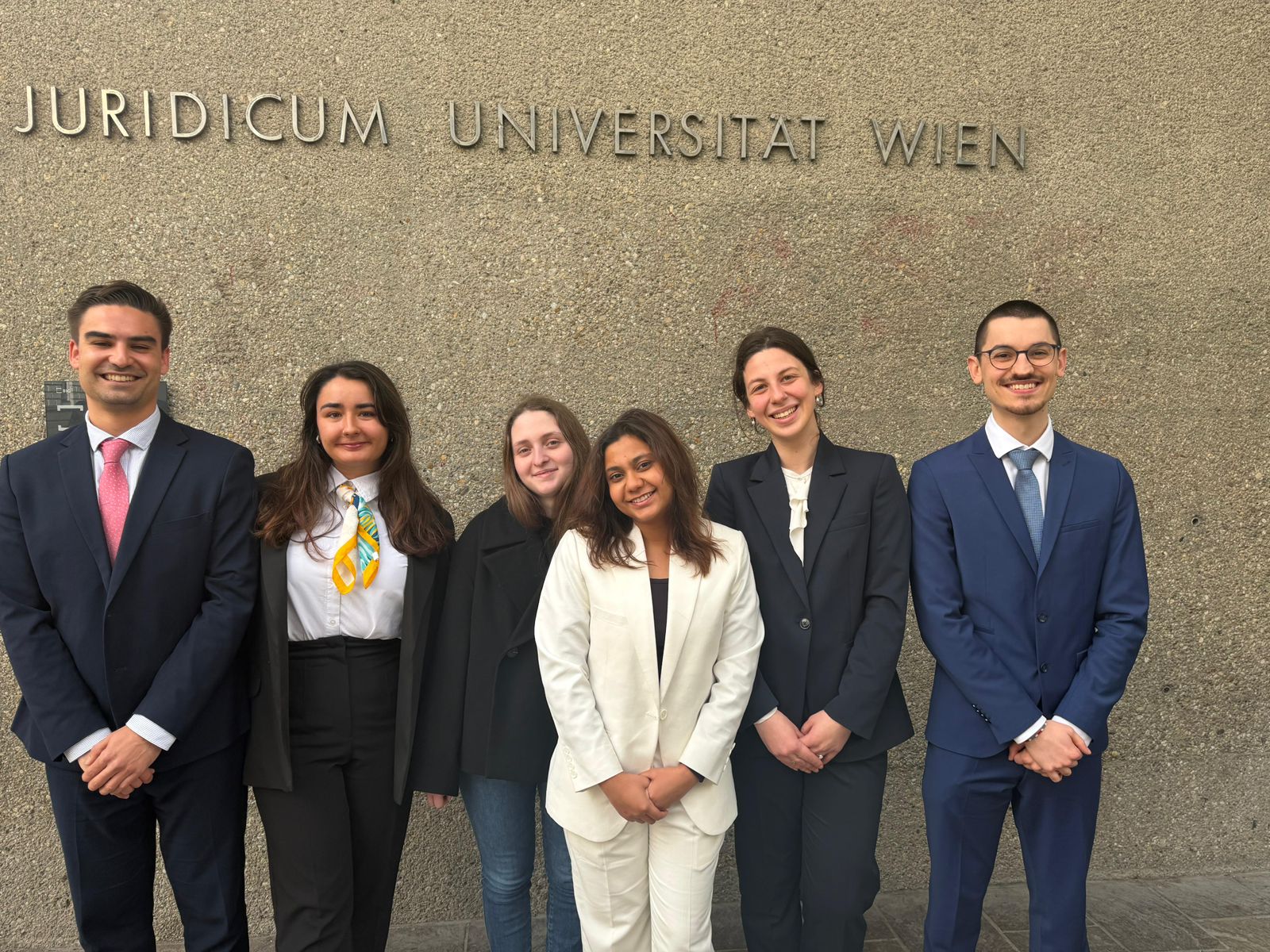
This year’s Moot Problem centered on the sale of orchids, in reference to Singapore’s national flower, as the arbitration rules of the Singapore International Arbitration Centre (SIAC) applied in the 33rd Vis Moot. The plaintiff, a company specializing in the cultivation and sale of rare flowers, sought damages for a covering sale it had made due to the defendant’s breach of a contract regarding the trade of a specific endangered species of orchid. The defendant was the spices division of a large food company that intended to use the flowers to produce high-quality vanilla. To that end, after acquiring a predecessor company, it had renegotiated the existing contract with the plaintiff and expanded it to a larger volume. Shortly before the planned delivery, the Committee of the Convention on International Trade in Endangered Species (CITES) changed the classification of the orchid, with the result that international trade was to be prohibited. The plaintiff had warned of such a decision and demanded an earlier delivery. The defendant relied on standard practice, assuming that the ban would not take effect immediately and that its country of origin would continue to issue import permits—an erroneous assessment. The defendant now invokes the “force majeure” provision of the CISG and the contract, arguing that it is not liable for damages. In the alternative, it rejects the calculation of damages under the CISG’s covering sale provision, as the sale was made by the plaintiff before the contract was officially terminated. In the alternative, it rejects the calculation of damages under the CISG’s covering sale provision, as the sale was made by the plaintiff before the contract was officially terminated. On the procedural side, the students had to address the content of the contractual arbitration clause and the question of whether the 2016 or 2025 SIAC Rules applied to the proceedings. Additionally, the case involved the question of whether the defendant’s motion for access to the plaintiff’s contracts regarding third-party financing should be granted. In two briefs, the students took on the roles of representatives for both sides, thereby learning how to defend their clients’ interests in a legal dispute.
From late January to late March, the team prepared for the competition in Vienna during the oral phase by practicing their arguments on precisely those issues. To this end, the team participated in pre-moots in Stuttgart (Gleiss Lutz), Fribourg, Athens, Brussels (Linklaters and White & Case), and Belgrade. The oral competition then took place in Vienna from March 27 to April 2. This year’s edition featured 384 teams from all countries and jurisdictions.
Further information on the Vis Moot can be found on the official website: https://www.vismoot.org/.
Report by Mika Schieffer
And here is the report on the Vis Moot 2025